
Two Hundred Dollars and a Question the Seller Couldn’t Answer
The listing said it upfront: the seller didn’t know the shutter count on this thing. Not hidden, not left off, just stated plainly in his own description that he wasn’t sure. That’s usually where a purchase like this gets shaky, because shutter count is one of the real tells on a camera’s condition and its likely remaining life, and I hadn’t even messaged him yet.
The listing also had exactly one photo. One. Not nearly enough to get any kind of real read on a twenty-year-old camera’s actual condition. So before I agreed to anything, I messaged the seller directly, asked about the shutter count, and asked for more photos while I was at it. He sent a few back, nothing fancy, just more angles than the listing had bothered with.


On the shutter count he gave me the same answer the listing already had: he still didn’t know, hadn’t looked into how you’d even check one. Two of my checks were already doing real work before I’d left the house: whether there’s real proof of condition to actually look at, and how a seller responds when you ask them something directly.
That left me doing the math sight unseen. Two hundred dollars isn’t a lot of money, but it’s also not nothing, and neither is the time it takes to drive out and meet a stranger. No shutter count, one photo, a seller who plainly couldn’t get me any more certain on the number that tells you the most about a camera like this. Was it still worth the risk, contingent on what I’d actually find once I was standing in front of the thing? I decided it was.
So I did what I’ve learned to do instead: I read the camera itself.
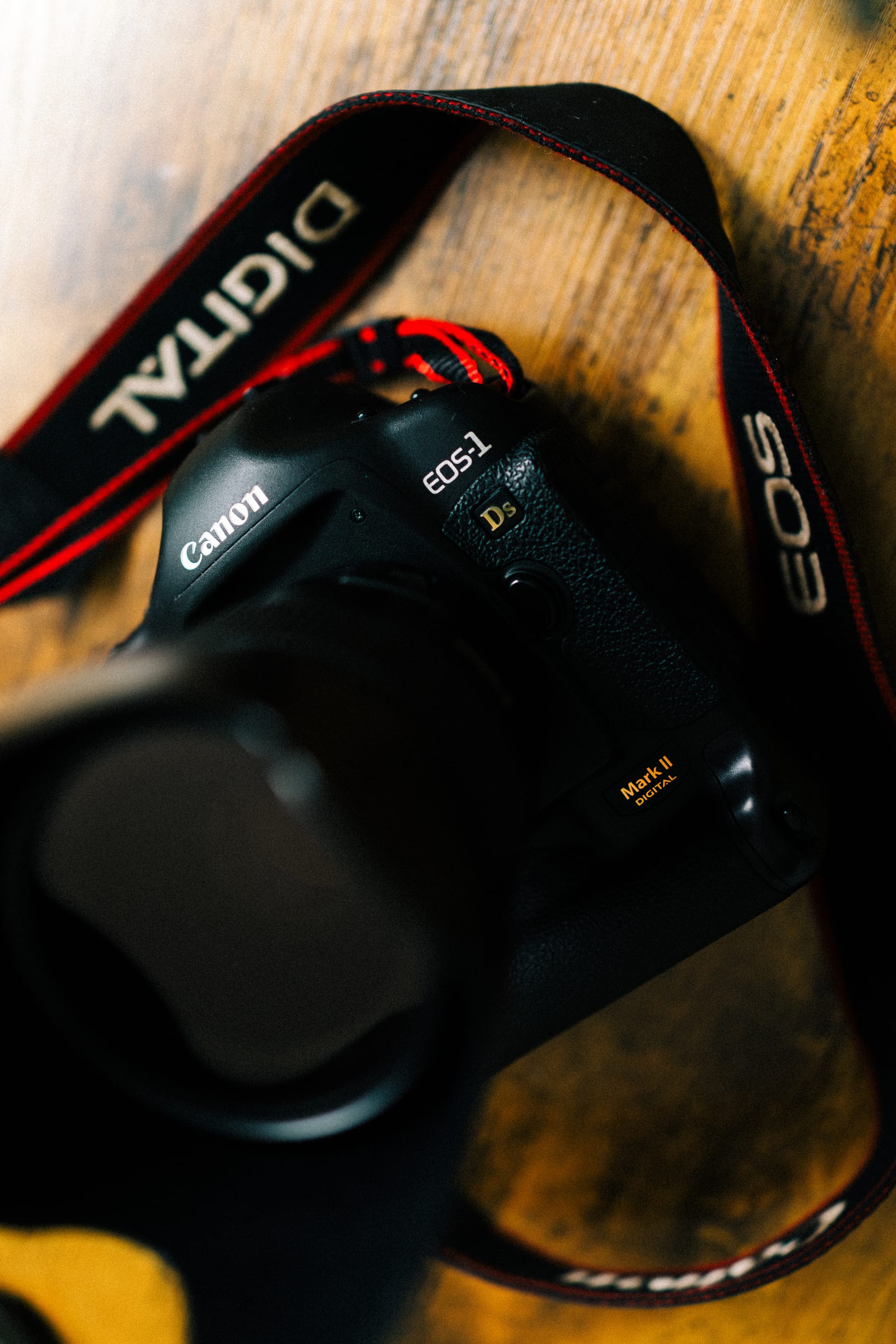
Overall it looked pretty clean. Not necessarily lightly used, I wouldn’t go that far, but generally well kept, with one real exception: the area around the grip showed noticeably more handling than the rest of the body, the kind of wear that comes from a camera someone actually used rather than just displayed. The strap backed that up in its own way. The sides of it looked almost brand new, barely worn at all, but the center section was a little dirty, the kind of dirty that reads like it just needs a wash, not like years of hard use catching up with it. Neither one was proof of anything on its own, but together they were enough to make the call to buy it and find out for sure once I got it home.
Two hundred dollars. For a Canon EOS-1Ds Mark II.
I’d owned this exact camera before.
The One I Let Go
I got into photography properly around 2005 to 2007. Canon is where I started, before I eventually moved to Sony gear years later. My first real DSLR was a Rebel XTi, then I moved up to a 5D Classic, and eventually to the 1Ds Mark II, chasing better autofocus, more resolution, and a body that could take the weather sealing seriously. I was working for the Miami Dolphins at the time and needed gear that could keep up.
At some point I let the 1Ds Mark II go and kept the 5D Classic instead. I’m honestly not entirely sure why. My best guess now, and it really is just a guess: maybe it was the 5D’s color rendering, maybe the noise performance, maybe just that it was the lighter body to carry around day to day. It’s the only thing I can really think of. Perhaps the value of it at that time was holding up better than the 5D’s. Who knows. I don’t have a clean answer for this one, and I’d rather say that plainly than invent a tidier story after the fact.
What I do know is that by the time I left the Miami Dolphins for Bethel Park, Pennsylvania, the 1Ds Mark II was already gone, and the 5D Classic was what came with me.
June 2026 is when I started getting back into photography seriously. I’d closed my business and wanted to return to what actually brought me joy and discipline in the first place, the cameras and gear I started with back in 2005 to 2007. That sent me back to OfferUp hunting for the 5D Classic and the 1Ds Mark II both. And on July 4, 2026, there it was. The exact model I’d let go of decades earlier, sitting on my radar again for two hundred dollars.
What I Actually Check Before I Buy
I’ve bought enough used gear at this point that I’ve settled into a real checklist, and it’s worth writing down properly instead of just describing the shutter-count moment and leaving the rest implied.
Cosmetic condition, in specific spots. Not just “does it look beat up,” but actually going over the hot shoe, the battery compartment, the bottom plate, the rubber grip material, the mirror if you can see it, the prism, the focusing screen. Small wear patterns in those specific places tell you more than a general glance does.
Strap condition, as a signal, not a guarantee. I already mentioned the strap on this one, sides looking nearly new, center section a little dirty in a way that read as needing a wash rather than years of hard use, and that combination was part of what got me to the yes. But I want to be honest about what that actually means. A body that looks clean isn’t necessarily a body that’s been lightly used. I’ve seen eBay listings where a cosmetically pristine camera turned out to have real functional problems underneath. Strap wear is one data point. It’s not a verdict.
Proof the camera actually works. Whether the seller has photos or video showing the camera powered on and operating, including how it sounds when the shutter and mirror fire. A seller who can show you that has usually actually handled the thing recently. On this one, the single photo in the original listing wasn’t proof of anything, which is exactly why I asked for more before deciding.
The listing itself. How the description reads, how much care went into the title. A rushed, vague listing is its own kind of information. This one had a single photo, which is that kind of information too, and it’s what pushed me to go get the rest of the picture myself instead of trusting what was already posted.
How the seller answers questions. I ask direct questions and pay attention to what comes back. A straight, detailed answer is one thing. A short, evasive one is another. Getting ignored entirely tells you plenty too. Asking this seller for more photos before I committed to anything was that same check running in real time, and he came back with them without any pushback.
A budget set before you start looking. Decide what you’re willing to spend on a piece of used gear before you’re standing in front of it, not while you’re standing in front of it.
Where the price actually sits in the market. Not just what the camera used to cost, but what similar copies are actually going for right now. More on that below, because in this case the number turned out to be genuinely good.
All seven of those were running in the background when I was talking to this seller, and none of them individually would have been enough to decide on their own. That’s kind of the point of having seven.
Getting It Home
Once I got the camera back, I gave it a proper clean. The handle grip had a lot of dirt and grime built up on it, more than I’d clocked in the listing photos, so it took some real time to work through. I cleaned it with 90% isopropyl alcohol, diluted with a bit of water, going slow around the grip texture and the seams. When I was done it looked better than what I’d seen online. Genuinely better, not just cleaner in a way I was talking myself into.
Then I checked the number that actually mattered.
The 1Ds Mark II doesn’t show you shutter count anywhere in its own menus. Canon never built that in on this generation. The way you get it is through the Maker Notes section of a photo’s EXIF data, which you pull with a third-party tool from a straight, unedited JPEG out of the camera. I ran mine through one.
14,400 actuations.
For a camera this age, that’s about as good as I could have hoped for. Canon rates the 1Ds Mark II’s shutter for 200,000 actuations, so mine is sitting at roughly 7% of its rated life. That’s my own arithmetic, not a number anyone handed me, but it lines up with what used-camera buying guides generally consider very light use, especially on a body over twenty years old.
I do want to be straight about what that number does and doesn’t tell you, because I don’t want to oversell it. Shutter count reflects wear on the mechanical shutter curtain specifically. It doesn’t tell you anything about sensor condition, battery health, or the overall state of the camera. More than one source in the material I dug into for this post makes the same point: it’s one data point, not the whole read. A camera with a lot of its shutter life used up but otherwise clean and well cared for can be a smarter buy than a low-count body that’s been knocked around. I believe that. It’s exactly why I run seven checks instead of leaning on any single one, shutter count included.
Still. 14,400 shots, a clean strap, a grip that cleaned up better than the photos suggested, and a seller who answered my questions straight. That’s a good picture, built out of several small ones, not one lucky number.
Inside the Body
I led with the parking lot and the checklist because that’s the part actually worth reading first, but the specs are worth laying out properly too.
Canon released the EOS-1Ds Mark II in November 2004, at a launch price of $7,999 for the body alone. It sat between the original EOS-1Ds from 2002 and the EOS-1Ds Mark III that came along in 2007, the high-resolution, studio-and-portrait end of Canon’s flagship 1-series, distinct from the sports-focused 1D line sharing the same chassis.
It shipped with a full-frame, 36x24mm CMOS sensor at 16.7 effective megapixels, which Canon itself claimed was the highest pixel count of any DSLR at the time of release. It runs on a single DIGIC II processor, not dual, worth stating plainly since it’s an easy detail to get wrong; the dual-processor 1-series bodies came later. A 45-point autofocus system, roughly 4 to 4.5 frames per second burst, a shutter rated to 1/8000s, and a weather-sealed body built for exactly the kind of outdoor pro work I was doing with it back in the Dolphins years.
Canon rates the shutter for 200,000 actuations. Mine’s at 14,400.
What It Cost Then, What It Costs Now
$7,999 in November 2004 is the obvious comparison, and it’s a real one, but it’s not the most interesting one. The more useful number is what this camera is actually worth on the used market right now, and how that’s moved over time.
The trend here is a lot noisier than what I found when I dug into the pricing on the Magic Drainpipe lens, and I’d rather say that upfront than force a cleaner story than the data actually supports. Roughly speaking, the camera dropped steadily in value from the mid-2015 range, when it was estimated in the $600 to $800 band on the used market, down into real reported purchase prices in the $150 to $400 range by the early 2020s. That’s a fairly ordinary decline for a body this old, out of production, no longer serviced by Canon.
Where it gets messier is the last five years specifically. From 2021 through today, the honest read is roughly flat within a wide band, somewhere around $150 to $400 depending on condition and where you’re buying it, rather than a continued clean slide downward. A private sale in 2022 went for around $150. Forum consensus more recently pegs a “fair” condition copy around $200. And right now, in September 2026, a well-used graded copy from MPB with 43,567 actuations, nearly three times my own shutter count, is listed at $264. An excellent-condition copy from the same dealer runs $399.
Two hundred dollars, for 14,400 actuations, against a graded “well used” comparable at $264 for 43,567 actuations. That’s a sharper number than the $7,999 launch price, and honestly the more useful one if you’re trying to understand whether this was actually a good deal.
One more thing worth mentioning, because it surprised me a little when I looked into it: being a former flagship professional body doesn’t seem to buy this camera any real protection on resale value. The depreciation on this 1Ds Mark II, from $7,999 down to the low hundreds it sells for today, works out to something like 95 to 97 percent, which is steeper in percentage terms than a comparable flagship-to-consumer gap I came across in a later Canon generation. The old assumption that pro-grade build quality holds value better doesn’t really hold up here. What it does seem to buy is a modest floor, driven by a smaller pool of people who still want this specific camera for what it is, not a market premium.
Coming Back to This One Specifically
I’ve got this camera back in rotation now, alongside the 5D Classic and the rest of what I’ve been reacquiring since June. These aren’t gear I’m planning to flip. They’re staying with me until they physically stop working, and after that they’ll make fine shelf pieces with a real story attached.


There’s something in the fact that the checklist I ran on this specific purchase, the strap, the grip, the questions to the seller, the shutter count pulled from EXIF data instead of trusting a stranger’s word, is a version of judgment I didn’t really have when I let this exact camera go the first time around. I’m still not sure why I sold it back then. I am sure I know what I’m looking at now, down to the actuation count. That’s not nothing.
Two hundred dollars, a camera I already had a whole history with, and a shutter that’s barely been used. I’ll take that as a pretty good second chance.