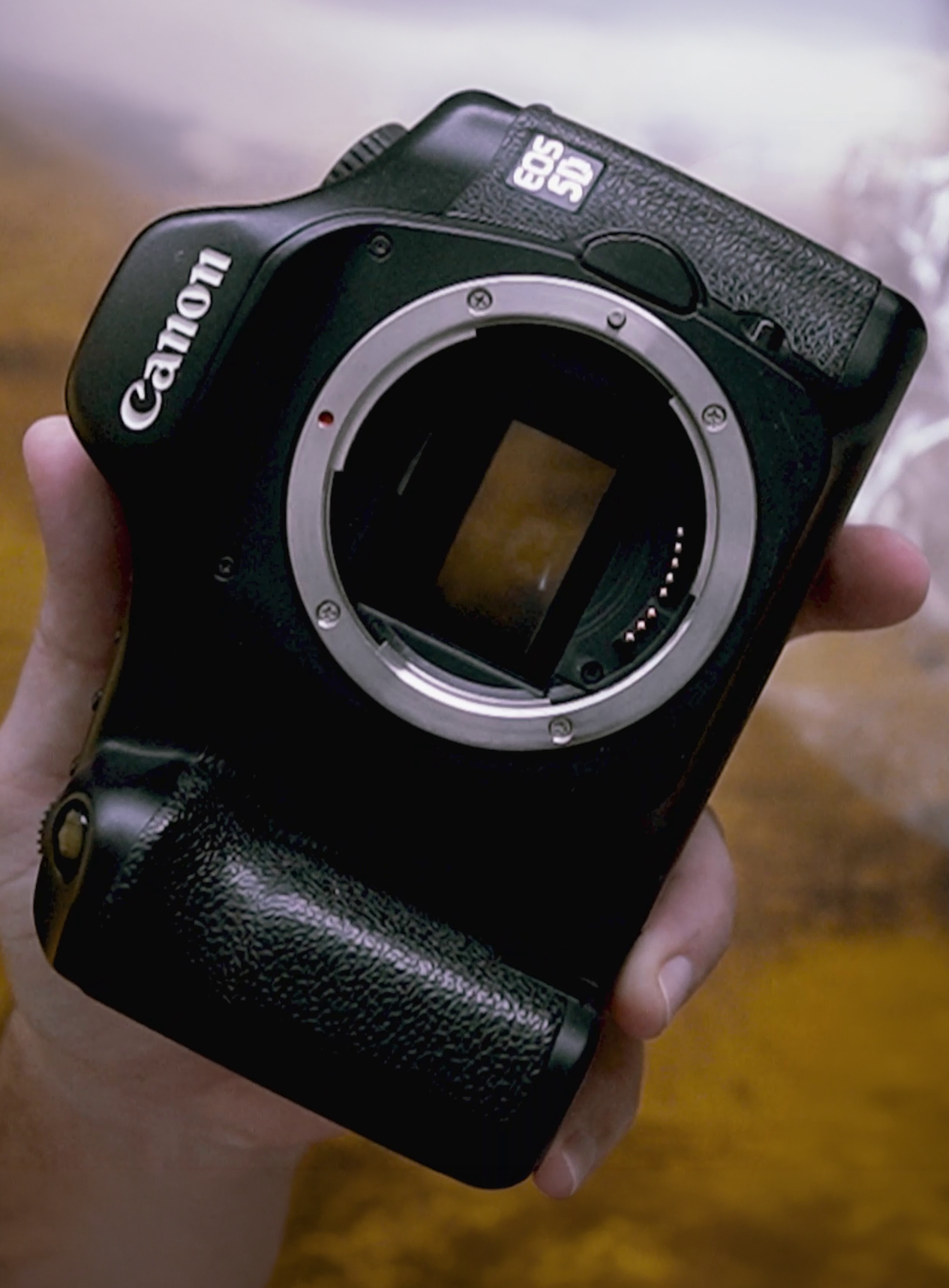
The Camera That Kept Showing Up
I don’t know why, but for the past few months the Canon 5D Classic kept popping up on my feed. The look of it, the feel of it, that portrait quality people keep going on about. It’s a strange thing to notice because it lined up with something I was already doing on my own Sony a7R III work: I’ve been deep in a phase of gold filters, bronze glimmer glass, black and bronze mist filters, anything that puts a specific effect on an image, mostly shooting Zeiss glass on that body. So when the 5D Classic kept surfacing while I was already chasing a certain look through filters, it started to feel less like a coincidence and more like a nudge.
The reputation itself isn’t new. I’ve already written elsewhere about the color case for this era of Canon glass, so I won’t rebuild that argument here. What matters for this post is just that the reputation did its job: it reminded me the 5D Classic was probably the camera body I got the most actual use out of before I ever touched a Sony. And once I started thinking about it that way, I realized the camera itself was only ever the last part of a much longer story.
The Long Way to the 5D Classic
That story starts with a Canon Rebel XTi, a crop-sensor body I picked up back in high school. A teacher saw something in the pictures I was taking and started handing me assignments, then actual client work, while I was still a student. It went from there into weddings and bar mitzvahs, and then, somehow, into professional sports: I ended up shooting as one of the photographers for the Miami Dolphins.
Somewhere in that stretch I moved from the Rebel XTi to a Canon EOS-1Ds Mark II, after a photographer friend rented one and wouldn’t stop raving about it. I found mine on Craigslist, from a guy out in Delray who’d used it professionally, landscape work mostly, though I think he also did underwater photography on the side. I never fully settled on it over the 5D Classic, honestly. The two are close enough in sensor and build that I spent a while going back and forth. The 1Ds Mark II was around 16 megapixels against the 5D’s barely 13, and I kept asking myself whether three extra megapixels actually mattered. Then there was the autofocus trade-off going the other way: the 1Ds Mark II had Canon’s flagship AF system, and the 5D Classic only gave you nine points.
That AF gap ended up mattering less than I expected, because shooting pro sports trained me to only trust one point anyway. Center AF point, back-button focus, every time. That habit got wired into me so deep that it’s still just my thing, all these years and camera systems later. It didn’t matter that the 5D Classic only had nine AF points to choose from. I was only ever using the one in the middle.
I shot the 5D Classic for around four years before I moved on to something else, though at this point I honestly don’t remember what came right after it. What I do remember is renting a 5D Mark II and never getting comfortable with it. Something about the sharpness, or the colors, I can’t pin it down exactly. I just knew that whatever I liked about the 5D Classic, the Mark II didn’t have it, and I told anyone who’d listen the same thing at the time.
Chasing the Darkroom, and Closing the Business
Underneath all of that, I was still itching for the darkroom. I loved picking a film stock, loading it, shooting it, developing it the way I wanted, scanning it, cleaning up the dust, and being done. So while I still had the 5D Classic in rotation, I started experimenting with medium format digital, a Leaf Valeo 22-megapixel back, before letting go of that entirely and going full film on a Fuji GX680. From there I kept pushing into higher-resolution formats, medium and large format both, because I had the funds to chase it and the curiosity to follow through.
Years later I started picking up clients overseas, and almost all of them wanted digital deliverables, not film. So I sold a Rolleiflex 2.8F to fund a Sony a7 II and a few lenses to go with it, and that became my digital answer for that chapter of client work. Worth being clear about this one, because it’s easy to mix up: that a7 II is a completely different camera from the Sony a7R III I still shoot today with my Zeiss glass. The a7R III isn’t going anywhere. The a7 II was always the more disposable of the two, bought for a specific job at a specific time, and by 2026 standards it’s a camera that’s had its run: Sony formally end-of-lifed it back in 2021, and it’s been sitting under a dozen-plus newer a7-series bodies ever since. Letting it go isn’t a hard call. It’s just the last loose end from a chapter that’s already closed.


And that chapter did close. Eventually I shut the photography business down entirely, after years of doing it. It wasn’t the photography itself that wore me down. It was the friction that kept building up on the client side, enough of it that I lost some of the enjoyment I used to have for the work and my own approach to it.
Back to the Roots, and Not the Only One
Which brings me back to where this post started. I’ve seen the discourse out there about photographers deliberately stepping back from mirrorless toward simpler cameras, and I want to be honest about what I think it actually is: a real conversation, happening among a specific, small group of people, not some industry-wide reversal. I’m not leaving mirrorless. My a7R III and my Zeiss lenses aren’t going anywhere. This is an addition, a specific return for a specific reason, not a system swap.
The reason, as best I can put it, is that I wanted to get back to what made me actually enjoy this in the first place. Not the megapixels, not the color grading, not the highlight and shadow preservation everything gets marketed on now. Back in high school, with the Rebel XTi and later the 1Ds Mark II, it was about the moment, not the spec sheet. I wanted something simpler again, and the 5D Classic checks that box about as well as anything can.
Once I started actually looking into it, half out of curiosity and half to talk myself into the purchase, it turns out I’m not the only one who thinks this camera is worth the trouble. There’s a whole quiet pocket of people still shooting the original 5D today, and by the time I was done reading through what they had to say, I honestly couldn’t tell where my own reasoning stopped and theirs started. Nobody’s calling it a comeback. It reads the way I’d describe my own thinking too, individual people rediscovering one specific camera for their own reasons, not some broader movement. So here’s the actual case for it, mine and everyone else’s, mixed together at this point.
Why I Actually Went Back to This Camera
The color. This is the thing that put the camera back on my feed in the first place, and it’s the thing that comes up more than anything once you actually start reading about this body: something about Canon’s color out of this era, warm, a little rough and organic at the edges of the highlights, that doesn’t look like what comes out of a modern sensor. I can’t fully explain why it works. I just know it does, and it’s the reason I noticed this camera again at all.
The resolution, or lack of it. Thirteen megapixels was never a ceiling for me. It was already more than most of my professional work ever needed, and I still think 20 megapixels is the sweet spot for anyone shooting seriously, then or now. Most of my professional work never needed more than 10, maybe 5. A low-resolution sensor and a genuinely useless rear screen mean you can’t chimp your way through a shoot. You actually have to trust your exposure instead of checking it every frame, and that ends up asking more of your attention, not less. That’s a feature, not something to apologize for.
No bells, no whistles. It doesn’t shoot video. It doesn’t have the resolution, the autofocus, or any of the stuff everyone chases today, and I’m fine with that. I don’t even want anything past 30 megapixels at this point, on any camera I own. That’s the whole point of this one, not a knock against it.
The price and the parts. It’s still genuinely cheap. I’ve seen these going for well under $300 used depending on condition, sometimes a fair bit less, and batteries and CompactFlash cards are still easy enough to track down. Between the price and the parts still being out there, there’s nothing stopping anyone from doing exactly what I just did.
What Was Actually in the Box
So I bought one from KEH. It came graded Excellent, and it looks the part, close to brand new at a glance. The serial number starts with 29, which puts it in the late-2007-to-early-2008 window of the run (Canon built these from 2005 to 2008), and there’s no way to pull an actual shutter count off this body the way you can on a 5D Mark II. So I’m working off a guess: the file numbering starts around 101 and runs to roughly 700 above that, which puts my estimate at under 2,000 actuations. It’s a guess, not a verified number, but it’s the best one I’ve got.


There’s a little wear on the bottom corners and on the hot shoe mount, which I covered up with a Sharpie so it doesn’t stand out. The one real gap was the rubber port covers, missing entirely from this copy. I tracked down a replacement on eBay for about fifteen dollars, which felt like a lot for a strip of rubber, and the install was more involved than I expected: two screws behind the leatherette, a few more on the plate itself, plus the screws on the bottom that also happen to hold the internal clock battery in place. Once the plate’s off, you have to work the cover into two grooves, and the left one gives you almost no wiggle room while the right side is far more forgiving. Fiddly, but doable.

I’ll also say something about the mirror-popping warnings that follow this camera around, because I don’t think the common version of the advice is quite right. The usual line is to avoid serial numbers that don’t start with 0, 1, or especially 2, since those are supposedly the bodies most prone to it. From my own experience, that’s not the whole story. I’ve owned two other 5D Classics with early- and mid-“2” serials, and one of them popped its mirror anyway, which I ended up fixing myself at the time. The other never gave me trouble, though I honestly don’t remember if that one had already been fixed before it got to me. So I’d call it a real risk worth knowing about, not a rule that holds cleanly. This particular body starts with 29, and so far it looks and feels fine.
All of which is really just a long way of saying why this camera, specifically, and not some other old body that would’ve scratched the same itch. The reasons up above are the real ones, not something I backfilled after the fact to justify a purchase. Holding it in my hands now, the wear, the Sharpie fix, the missing port covers and all, just puts some weight behind them.
I haven’t shot a frame with it yet, but I know there’s more coming. Probably a few more odd purchases in this direction before I’m done, and if I’m honest, this is really the start of something I want to keep documenting as it happens rather than close out in one post: the purchases, the small repairs and replacement parts, whatever else turns up along the way, more like a running journal than a single verdict.
So think of this as one entry in that record, not the whole story. This one’s just the camera that got me back to paying attention to what I’m doing behind the viewfinder again, instead of what’s on the spec sheet. Expect more of these as the rest of it unfolds.